NFC cashless at events: how it works and what it actually costs
Wristbands, top-up points, offline balances and refunds - a practical guide to cashless payment at festivals, including the failure modes nobody mentions in the sales deck.
- Events
- Cashless
- NFC
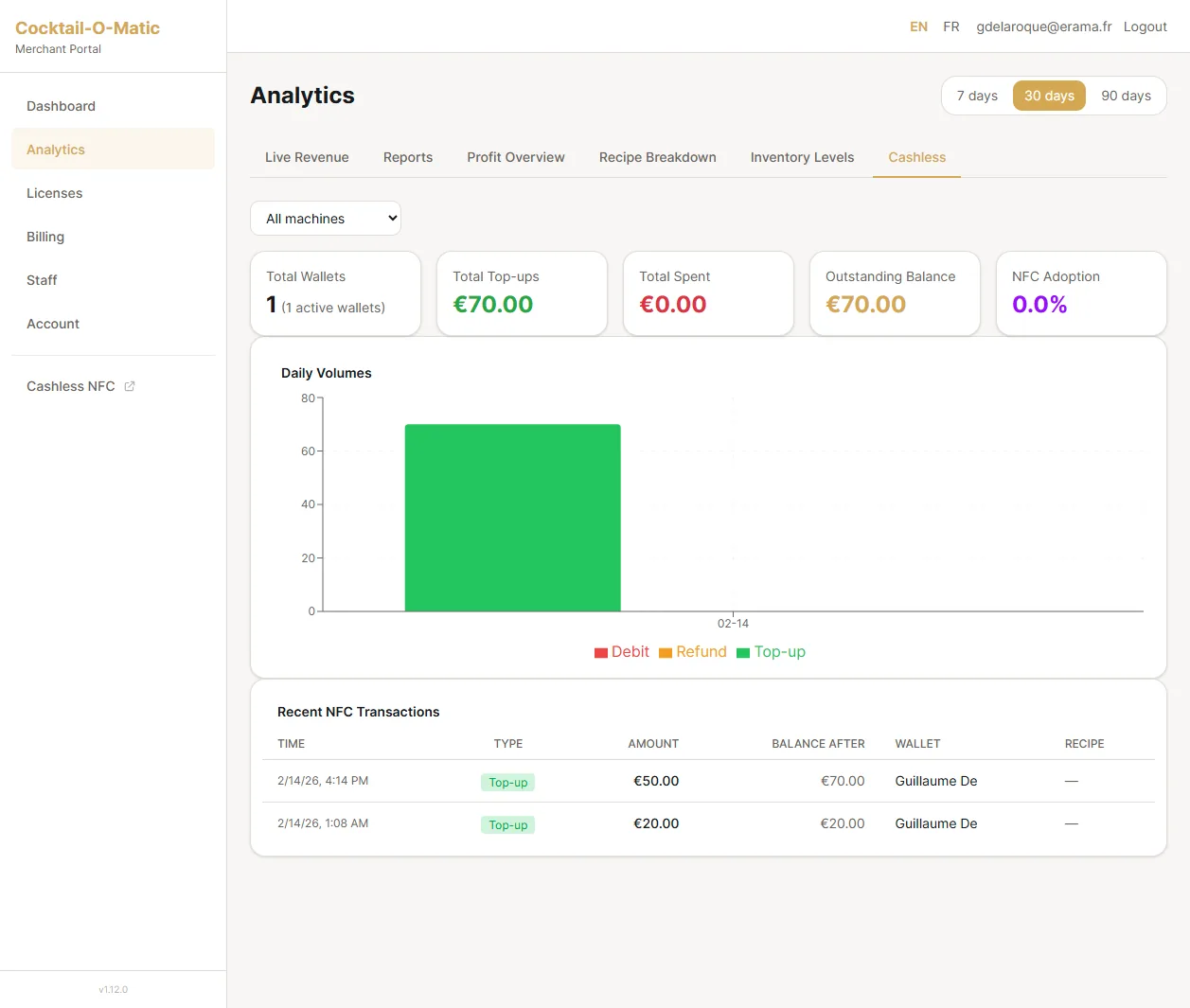
Cashless has become the default at festivals for good reasons: bars serve faster, staff handle no money, and the organiser gets a real-time view of what is selling. It also introduces a set of problems that only show up on site, and those are what this guide is about.
How it works, mechanically
An NFC wristband or card carries an identifier. That identifier maps to a wallet balance. A guest taps at a bar, the balance is debited, the drink is served.
The critical design question is where the balance lives:
Balance on the server. Every tap is a network call. Clean model, complete audit trail, and completely dependent on connectivity - which is exactly the thing an event site loses at peak. When the network drops, bars stop.
Balance on the tag. The wristband itself stores the value. Works with no network at all, but a lost wristband is lost money and the security model has to be taken seriously.
Balance local, reconciled. Each bar holds the balances it needs and syncs when it can. This is the model that survives a bad network, and it is why offline-first design matters so much in this context.
Cocktail-O-Matic currently uses the first model: wallets live in the cloud, and the machine calls the cloud to check a balance and to debit it. That is a deliberate trade - one authoritative balance, no risk of a wristband being spent twice at two bars - and it means the cashless path needs connectivity at the moment of payment.
Worth being precise about what that does and does not affect. Recipes, pump control, the guest kiosk and licensing all keep working offline, so a machine with no network still pours; the grace period covers the licence side for seven days by default. It is the NFC debit specifically that requires the cloud to be reachable. If you are planning a site with poor connectivity, that is the constraint to design around: a dedicated, tested link to the bars, rather than relying on the same saturated cells your guests are using.
The three things that go wrong on site
Top-up becomes the bottleneck. People fix the bar queue and forget the top-up queue. If you have eight bars and two top-up points, you have moved the queue rather than removed it. Plan roughly one top-up capability per bar, and make sure staff can top up from anywhere - a phone-based cashier app does this far better than fixed terminals.
Wristbands fail to read. Some get damaged, some get worn under a sleeve and a coat, some are simply bad tags from the batch. Budget 1 to 2% of wristbands needing replacement, and have a documented process for transferring a balance to a new tag - because you will be doing it in the dark in front of an impatient queue.
Refunds at the end. This is the part that generates every complaint. Guests finish with money on their band and want it back. Decide the policy before the event, publish it clearly at the point of top-up, and make sure the technical means of doing it exists. Retro-fitting a refund process after the event is miserable, and unspent-balance rules vary by jurisdiction - check what applies to yours before you set the policy.
The economics
Cashless is usually sold on increased spend per head. The gains that hold up in practice:
- Faster service means more transactions in the same peak window. This is the real one.
- No cash handling removes counting time, float management and shrinkage.
- Complete data: what sold, where, when. Most operators find this is worth more than the speed, because it changes how they plan the next event.
The costs, honestly:
- Wristbands or cards, per attendee
- Top-up infrastructure and the staff to run it
- Some percentage of guests who have a bad experience and remember it
The break-even is usually driven by event size. Below a few hundred attendees, the wristband and setup cost rarely justifies itself against a card terminal. Above a few thousand, the throughput gain dominates everything else.
What to insist on
If you are specifying a cashless system for an event, these are the requirements worth being firm about:
- Bars keep serving when the network drops. Non-negotiable on a large site.
- Top-up works on a phone, not just at a fixed kiosk. Staff mobility is what keeps top-up queues short.
- Balance transfer between tags is a supported operation, not a database edit.
- Live consolidated view across all bars, so the organiser can see a bar running dry before its staff report it.
- Data export you actually own, in a format you can use after the event.
Cocktail-O-Matic meets points 3 through 5 and part of point 2: top-ups and refunds from a cashier web app, live consolidation across every machine, and transaction CSV export from the cloud portal.
Three honest gaps, since this list is only useful if we hold ourselves to it:
- Point 1 is not met for the payment itself. As above, the debit is a cloud call. Drinks keep pouring offline; NFC payment does not.
- The cashier app uses the Web NFC browser API, which today means Chrome on Android. An iPhone has the NFC hardware but cannot drive it from a browser, so plan your staff devices accordingly.
- Moving a balance from a damaged band to a new one is not yet a single operation: you can deactivate a wallet and create the replacement, but the transfer is a manual sequence.
The cashless feature page has the detail, and the events page covers how it fits a multi-bar site.
When not to bother
Cashless is not automatically right:
- Small private events. For a wedding or a corporate party of 150, a wristband system is overhead with no queue to solve.
- Single-bar venues. A permanent bar with one serving point gains little; card payment is simpler and guests already have the card.
- Events with no top-up staffing. If nobody is dedicated to top-ups, the system will fail at its weakest point and everyone will blame the technology.
The honest test: do you have a queue problem at peak? If yes, cashless plus self-service is a serious answer. If no, you are buying infrastructure to solve a problem you do not have.