Pump calibration: the difference between a machine and a gadget
How to calibrate cocktail machine pumps properly - the weighing method, what makes flow drift, how often to re-measure, and how to do it on 40 pumps without losing an evening.
- Hardware
- Calibration
- DIY
Every automated cocktail machine that disappoints its owner disappoints them the same way: the drinks are inconsistent. Not undrinkable, just off - a little strong on Tuesday, watery on Saturday, and nobody can say why.
The cause is almost always calibration. It is the least interesting part of the build and the one that decides whether you have a machine or an expensive gadget.
Why a pump does not know how much it poured
A pump has no idea what volume it moved. It spins for as long as you tell it, and the volume that comes out is a consequence of the motor, the tubing, the liquid and the plumbing around it. Your software converts a recipe volume into a run time using one number: the flow rate you measured.
If that number is wrong by 10%, every drink using that pump is wrong by 10%. If it is right today and drifts by 10% over three months, your drinks drift with it and nobody notices until a regular complains.
Calibrated by what, exactly
Before the procedure, one distinction that changes it. What you measure depends on how the line is driven:
| Line type | Calibrated by | What you store |
|---|---|---|
| DC motor pump | Time | Millilitres per second |
| Solenoid valve, gravity-fed | Time | Millilitres per second |
The method below is identical in both cases - run for a known duration, weigh the result, divide. Both dose on elapsed time, which is why an undersized supply shows up as a short pour on every line at once.
The weighing method
This is the whole procedure, and it takes about a minute per pump.
- Prime the line. Run the pump until liquid flows steadily. Measuring a line that still contains air gives you a number that is too low.
- Put a container on a kitchen scale and tare it.
- Run the pump for a fixed duration. Thirty seconds is a good compromise - long enough that your reaction time does not matter, short enough that you are not standing there all night.
- Read the weight in grams. For water, spirits and most mixers, 1 g is close enough to 1 ml. If you want to be exact with a syrup, divide by its density.
- Divide by the duration. 47 g in 30 seconds is 1.57 ml/s. Store that per pump.
Use a scale, not a measuring cup. A jug graduated in 25 ml increments cannot resolve the difference between a good pump and a bad one, and that difference is exactly what you are trying to capture.
What actually makes flow drift
Understanding this tells you when to re-measure, which matters more than the measurement itself.
| Cause | Effect | What to do |
|---|---|---|
| Tubing wear (peristaltic) | Flow drops gradually as the tube flattens | Re-calibrate at each tube change, and once a season |
| Liquid viscosity | Syrups and cream liqueurs flow much slower | Calibrate with the liquid the line will actually carry |
| Temperature | Cold liquid is more viscous, so slower | Calibrate at service temperature, not at 06:00 in a cold room |
| Bottle height and level | Gravity-assisted paths slow as the bottle empties | Keep bottles at a consistent height; calibrate in the final position |
| Air in the line | Wildly low readings, inconsistent pours | Prime before measuring, check every connector |
| Supply voltage sag | DC pumps and valves slow when several run at once | Size the power supply properly - see the build guide |
| Bottle level (valve lines) | Gravity feed slows as the bottle empties, since the head drops | Calibrate a valve line at a typical mid-bottle level, not on a full one |
The last one catches people out. If you calibrate pumps one at a time on an undersized supply, every single-ingredient measurement is correct and every three-ingredient cocktail is short. If your drinks are only wrong when the recipe is complex, suspect the power supply before the calibration.
Dose by volume, always
This is worth stating on its own because it is the most common design mistake in home-built software.
Store recipes as volumes: 40 ml gin, 20 ml lemon, 10 ml syrup. Store calibration per pump, in whatever unit that pump is driven by. Compute the run time at pour time.
The moment a recipe stores seconds, it is welded to one physical pump on one particular day. Swap a bottle to a different line and the recipe is wrong. Change a tube and the recipe is wrong. Move the machine and the recipe is wrong. Every recipe you ever wrote becomes disposable.
Verifying, not just measuring
Calibration is a measurement, so it can be wrong. Verify it before you trust it:
- Pick a pump and ask the machine for exactly 100 ml.
- Weigh what comes out.
- Anything within 2 to 3% is fine. More than 5% and something in the list above is at play.
Do this once after calibrating and once a month during a busy season. It takes two minutes and it is the only way you find drift before your customers do.
Doing this on 40 pumps
At six pumps calibration is a pleasant hour. At forty it is an afternoon, so the process has to be industrialised:
- Calibrate in parallel where the hardware allows it. If your supply can run four pumps at once, weigh four containers. But then verify a full recipe afterwards, because parallel running is exactly the condition where a weak supply shows up.
- Group by liquid family. Pumps carrying spirits behave alike, syrup lines behave alike. Calibrating one of each family and spot-checking the rest is a legitimate shortcut once you have a season of data showing the families are consistent.
- Keep the numbers, dated. A pump whose flow rate has dropped 20% over two seasons is telling you its tube is about to fail. That is preventive maintenance you get for free, and only if you kept the history.
- Re-calibrate the line, not the machine. When you swap one tube, re-measure that pump. Redoing all forty because one changed is how people end up never doing it.
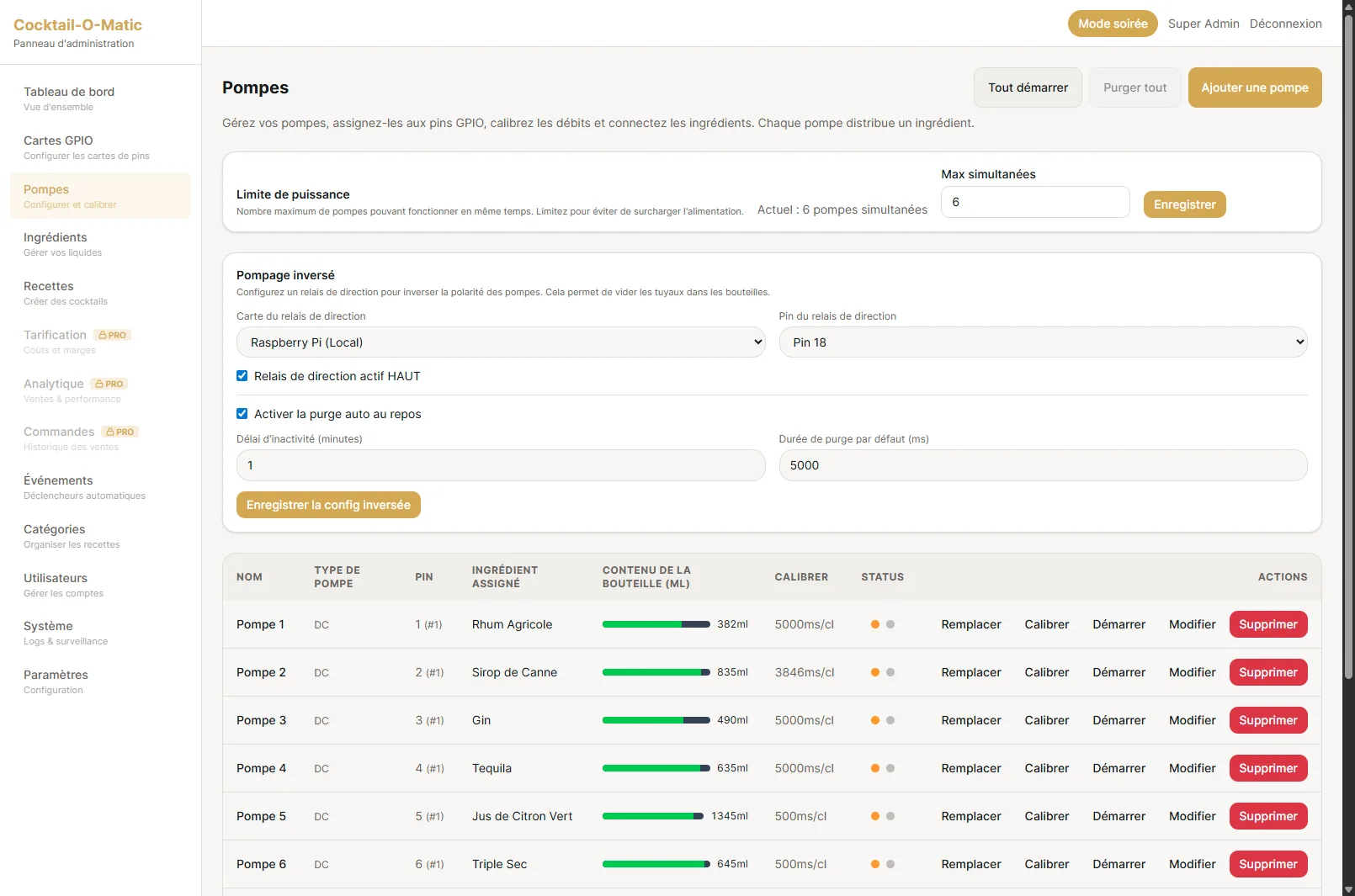
Cocktail-O-Matic stores calibration per pump and exposes it in the admin panel, with the filling gauges reading from the same values - so a pump that is drifting shows up as gauges that no longer match reality. The hardware page covers how that is wired up, and you can poke at the actual screens in the live demo.
When to stop caring
Some honesty: not every line deserves this rigour.
A pump dispensing 150 ml of tonic into a long drink can be 5% out and nobody on earth will notice. A pump dispensing 10 ml of a strongly flavoured bitter cannot be 5% out, because that is half a millilitre of something engineered to be tasted at that dose.
Spend your calibration effort in inverse proportion to the volume dispensed. Small doses of powerful ingredients are where precision earns its keep, and where a machine genuinely outperforms a human hand.