How many pumps do you need? Designing a menu around the machine
Pump count is a menu decision, not a hardware one. How to work out the number you need from the drinks you want to serve, and why six good lines beat twenty badly chosen ones.
- Planning
- Recipes
- Hardware
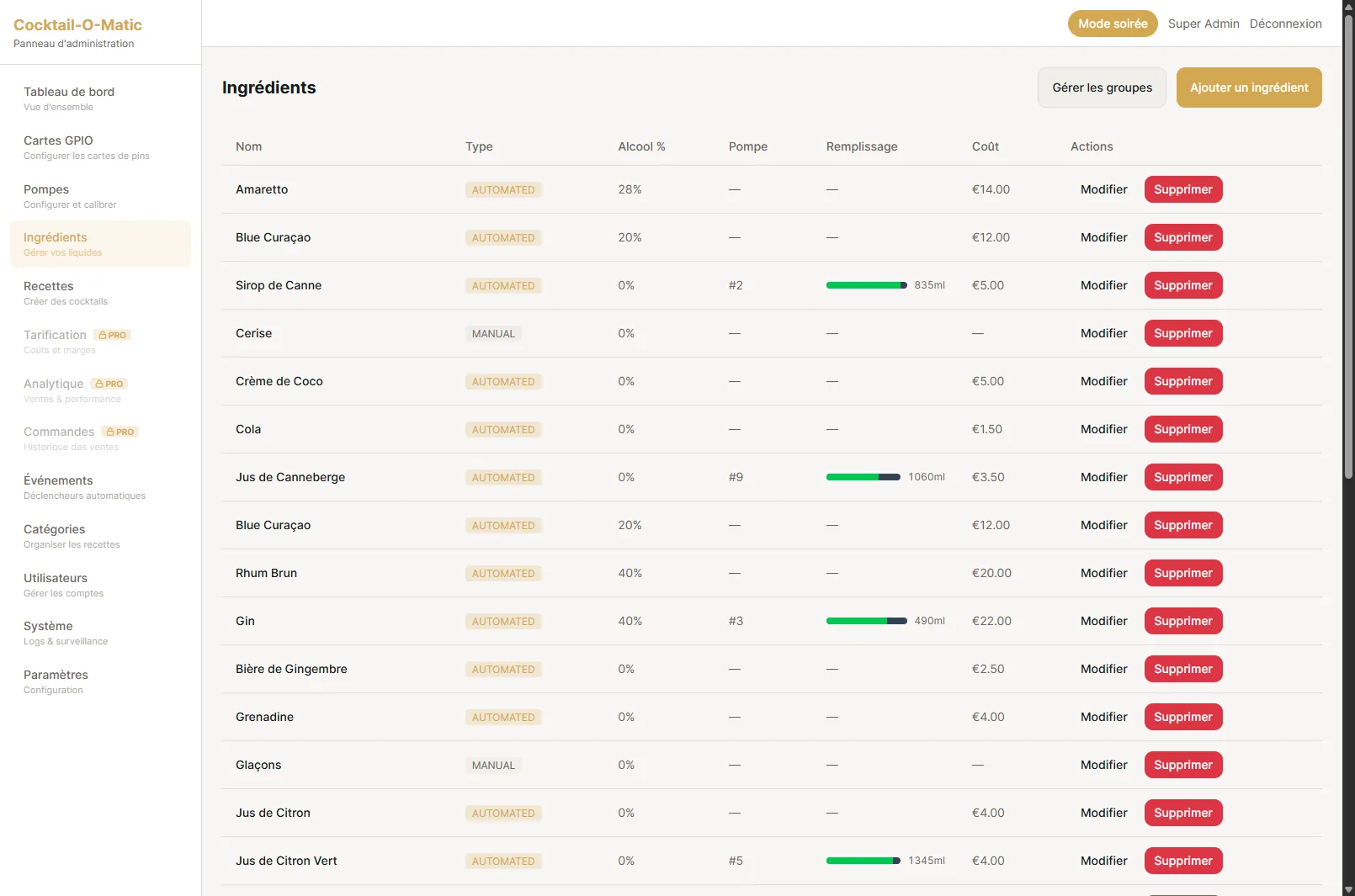
“How many pumps should I get?” is the first question everyone asks and the wrong one to start with. Pump count is an output, not an input. The input is the menu.
Here is how to derive one from the other.
Start from the drinks, not the hardware
Write down the drinks you actually want to serve. Not a fantasy list - the ten or fifteen that will represent 90% of what leaves the machine.
Now list every ingredient across all of them, and count how many drinks use each one. You will find a shape that repeats in almost every bar:
- Three or four ingredients appear in most of the menu (a base spirit, a citrus, a syrup, a long mixer)
- A middle group appears in two or three drinks each
- A long tail appears in exactly one drink
That tail is the entire question. Each single-use ingredient costs you a pump, a bottle, a tube and a cleaning cycle, and buys you one menu line.
The arithmetic that matters
The number worth optimising is not pump count, it is drinks per pump.
| Setup | Pumps | Drinks served | Drinks per pump |
|---|---|---|---|
| Badly chosen | 12 | 9 | 0.75 |
| Well chosen | 6 | 11 | 1.8 |
| Well chosen, larger | 16 | 30+ | ~2 |
A well-designed six-pump menu genuinely beats a careless twelve-pump one - fewer bottles, less cleaning, faster service, and a menu that survives one ingredient running out.
The way you get there is by choosing ingredients that combine. Gin, vodka, lime, sugar syrup, tonic and soda is six lines that produce a gin and tonic, a vodka soda, a gimlet, a Tom Collins, a vodka lime soda and several more. Six lines dedicated to six single-use liqueurs produce six drinks and nothing else.
Sizing brackets
Once you have your ingredient list, these brackets are a reasonable guide:
5 to 6 pumps. Home builds, small offices, tasting events. Covers a focused menu of 8 to 12 drinks if the ingredients are chosen to overlap. The free Community licence supports five, which is genuinely enough for most home machines; a sixth line needs a paid licence.
8 to 12 pumps. Small bars, restaurants with a cocktail list, private events. Room for two base spirits, a proper set of modifiers, and two or three long mixers. The practical sweet spot for a venue with a real menu.
16 to 24 pumps. Busy bars, permanent installations, venues that want the machine to cover the whole cocktail list rather than a subset. At this point you need I2C expansion because you have run out of usable GPIO pins.
40+ pumps. Festivals and multi-bar events, where the machine is the bar rather than an assistant to it. Cocktail-O-Matic supports this range, and the hardware page covers how the addressing works.
The mixer trap
Long mixers - tonic, soda, cola, juice - are where pump choice gets misjudged twice over.
They dominate pour time. A 150 ml tonic through a peristaltic pump takes a minute on its own, and it is the single biggest reason a machine feels slow. This is the argument for keeping peristaltic precision for the spirits and putting the bulk lines on something faster - a diaphragm pump, or a gravity-fed line behind a solenoid valve, which moves large volumes quickly and has no pump to wear out. The trade is that a valve line needs its bottle mounted above the nozzle, so it constrains your layout rather than your budget.
They also carbonate badly. Anything sparkling loses its fizz going through a pump, which is a real limitation rather than a tuning problem - covered properly in what automation can and cannot do with carbonated drinks.
The pragmatic answer many venues land on: automate the precise part, top up the fizzy part by hand. That is not a defeat. It is a machine doing the half of the job it is genuinely better at.
Plan for substitution
Whatever number you land on, the machine will at some point run a line dry mid-service. What happens next is a software question, not a hardware one.
Good software lets you declare which ingredients are interchangeable, hides what it truly cannot make, and tells you which bottle to change first. Bad software offers the guest a drink it cannot produce and fails at the last second.
Cocktail-O-Matic does this with ingredient groups: you define the set, and any member that is currently connected satisfies a recipe calling for that group. Put your two vodka brands in a group and a recipe asking for vodka works with whichever bottle is on the line. The groups are yours to define, so how far you push the equivalence - identical brands only, or genuinely different ingredients you consider substitutable - is your call, not a judgement the software makes for you.
Design your ingredient list so that the common ingredients have a plausible understudy. A menu where every single drink depends on one unique ingredient is a menu that collapses the moment that bottle empties.
Leave room, but not too much
A last piece of practical advice: buy a driver board with more channels than you need today. Going from 6 to 8 pumps on an 8-channel board is an afternoon. Going from 8 to 10 when your board has 8 channels means rewiring everything.
But do not fill those channels just because they exist. An empty line costs nothing. A line with a bottle you use twice a month costs cleaning, stock and a slot you would rather have given to something people order.
If you are still deciding, put your candidate menu into the live demo and see how it feels - the recipe builder there is the real one, and it will tell you quickly which of your ingredients are pulling their weight.